Hampstead Architecture and Planning

Enfield

House Extension Architects in Cockfosters

Trent Park is a designated heritage asset in its own right — a Grade II registered park and garden — and it is on the Heritage at Risk Register, with incremental development named among the factors putting it there. That is an unusual thing for a homeowner nearby to know, and it explains why small changes here are examined more carefully than their scale alone would suggest.

Last updated

The short answer

How does Trent Park affect building in Cockfosters?

Only where your property genuinely sits in its setting — and for most addresses it does not. Where it does, the park is a Grade II registered heritage asset on the Heritage at Risk Register, and incremental development is a named cause of that risk, so small proposals are weighed cumulatively rather than dismissed as negligible. Match the established pattern along the edge, take the space where it cannot be seen from the park, and include something that improves the boundary.

Planning at a glance

Cockfosters

Planning at a glance in Cockfosters
Local planning authorityEnfield
Likely approval routeHouseholder planning application or permitted development, depending on conservation status, listing and property type — confirmed for the exact address before drawings begin
Statutory determination time8 weeks for most householder applications (13 weeks for major applications)
Typical drawing package£2,250–£3,250 inc. VAT, fixed fee. Find my package →

Establish first whether your property has any real relationship with the park, because most Cockfosters houses do not and it is important to say so. A registered park and garden is a designated heritage asset and its setting is a material consideration, but setting means the surroundings in which the asset is experienced. A rear extension on a suburban street with no view of the park, not visible from within it and not on an approach to it, affects nothing — and a competent assessment should say that plainly rather than manufacture an issue.

Where a plot does adjoin or overlook the park, the relevant significance is landscape significance rather than architectural. What matters is the experience of a designed landscape of lakes, woodland and open ground: views out from the park towards its edges, the character of the boundary between park and development, and the extent to which built form intrudes on the sense of an enclosed and largely wooded place. Height, roof form and materials read differently against a treed backdrop than against a street.

The Heritage at Risk position sharpens all of it. When a register entry names incremental development among the causes of deterioration, small proposals stop being individually negligible in the assessment — the officer is entitled to consider what the accumulation of similar changes would do, because that accumulation is precisely the identified problem. The practical response is not to give up but to match: keeping to the established building line, height and boundary treatment along the park edge, and taking additional space where it does not read from the park at all.

Away from that edge the ordinary suburban rules apply. On an undesignated Cockfosters house, Class A covers a single-storey rear extension, prior approval allows a materially deeper one on neighbour notification, and a side extension is available within the half-width limit. Inside the Trent Park conservation area those change in the usual way, with side and roof extension rights removed and prior approval unavailable.

Local analysis

What matters in Cockfosters

What a registered park and garden means for a nearby house

Registered parks and gardens are the least familiar of the heritage designations and are frequently assumed to be advisory. They are not. The Register of Historic Parks and Gardens is maintained by Historic England under the Historic Buildings and Ancient Monuments Act 1953, and a registered site is a designated heritage asset in the same family as a listed building or a conservation area, graded I, II* or II — Trent Park is registered at Grade II. Registration does not bring its own consent regime in the way that listing does, so there is no separate "registered park consent" to apply for. What it does is make the effect of a proposal on the site, and on its setting, a material planning consideration that has to be addressed, with the conservation of the asset attracting substantial weight under the Framework published on 17 August 2026. Two features distinguish it from a listed building in practice. The first is that the significance is landscape significance: designed views, the disposition of woodland and open ground, water bodies, planting and the relationship between all of them, accumulated over the site’s development — here from a late 18th century landscape park through 19th century development and Sir Philip Sassoon’s early 20th century work with Norah Lindsay. Harm is therefore usually about intrusion into views and erosion of the landscape’s edges rather than about proximity to a building. The second is scale: a park of this size has a long boundary and many neighbours, so its setting is a much larger and more diffuse thing than a single building’s. That cuts both ways for a homeowner. It means more properties fall somewhere in that setting than would around a listed house. It also means the great majority of them are in positions where they have no real effect at all, and the honest assessment for most Cockfosters addresses is exactly that.
Heritage at Risk, and why incremental change is treated seriously

Historic England maintains the Heritage at Risk Register to identify designated assets whose condition or vulnerability puts their significance at risk, and Trent Park is on it: condition assessed as poor, vulnerability high, trend deteriorating. The named contributing factors are worth reading carefully, because they explain how proposals nearby are likely to be received. They include lapsed woodland and grassland management, siltation in the designed waterbodies — both maintenance and management matters largely outside a homeowner’s control — and incremental development, which is not. Incremental development means the accumulation of individually modest changes: extensions, outbuildings, boundary alterations, hard surfacing, lighting, tree loss, each small and none decisive, which together erode the character of the landscape and its edges. When that is a named cause of an asset’s deterioration, the ordinary planning answer that a particular proposal is too small to matter loses its force. An officer assessing a scheme in the setting of an at-risk asset is entitled to weigh the cumulative effect, because the cumulative effect is the identified problem, and to expect proposals to be justified against it rather than assumed to be neutral. Three practical consequences follow for a scheme genuinely within the park’s setting. First, evidence matters more: showing what the established pattern along that edge already is, and demonstrating that your proposal sits within it, answers the cumulative argument directly. Second, restraint at the visible edge buys freedom elsewhere — taking the space at the rear, below the ridge, behind existing planting, removes the effect entirely rather than mitigating it. Third, anything that improves the edge — retaining or reinforcing boundary planting, removing an unsympathetic later structure, reducing hard surfacing — is worth including and worth stating, because a proposal with a positive element is assessed under HE5 on that basis rather than only on what it takes away.

Thinking about a project in Cockfosters?

Send the address and a short description. We will confirm the likely approval route and the drawings your project needs.

Local planning

Planning & conservation context

Trent Park is registered at Grade II on the Register of Historic Parks and Gardens, kept by Historic England under the Historic Buildings and Ancient Monuments Act 1953. A registered park and garden is a designated heritage asset, so proposals affecting it or its setting are assessed as heritage matters.

Trent Park was designated a conservation area in 1973, extended to include Cockfosters Cottages in 1990 and the area around Chalk Lane in 1993. Monken Hadley, a Barnet designation, also falls within 1,400 metres of the checked point.

Heritage policy is set by the Framework published on 17 August 2026. It gives substantial weight to conserving a designated heritage asset, and asks under policy HE5 for the effect on significance to be placed in one of four categories — a positive effect, no effect, harm whose degree is identified, or total loss — with HE6 then determining how that finding is weighed against everything else.

The park is a late 18th century landscape with lakes and woodland, developed through the 19th century and further in the early 20th by Sir Philip Sassoon with advice from Norah Lindsay. Its significance is landscape significance — views, planting, water and the relationship between them — rather than the significance of a building.

The park is on the Heritage at Risk Register with its condition assessed as poor, high vulnerability and a deteriorating trend. Named contributing factors include lapsed woodland and grassland management, siltation in the designed waterbodies, and incremental development.

Because incremental change is itself part of the identified problem, the cumulative effect of small proposals is a live consideration in a way it is not everywhere — which makes matching what is already established locally the strongest position for any scheme within the park’s setting.

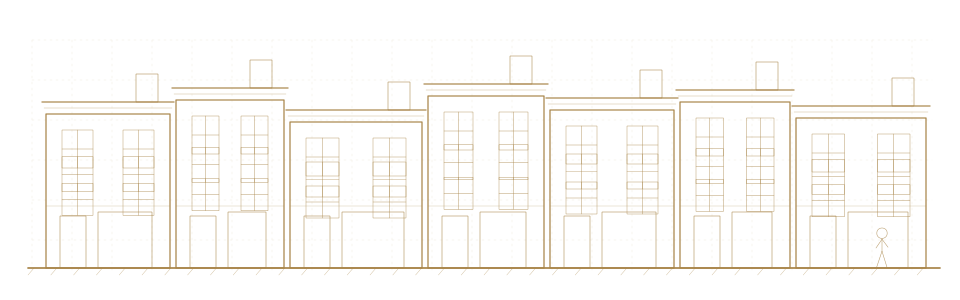
Illustrative study — street elevation

Architecture in Cockfosters: FAQs

Does Trent Park affect my extension?

For most Cockfosters houses, no — and a competent assessment should say so rather than manufacture an issue. A registered park is a designated heritage asset and its setting is a material consideration, but setting means the surroundings in which the asset is experienced. A rear extension with no view of the park, invisible from within it and not on an approach, affects nothing.

What is a registered park and garden?

A designated heritage asset on the Register of Historic Parks and Gardens, maintained by Historic England under the Historic Buildings and Ancient Monuments Act 1953, graded I, II* or II — Trent Park is Grade II. There is no separate consent regime, but the effect of a proposal on the site and its setting is a material planning consideration.

How is the significance different from a listed building?

It is landscape significance: designed views, the disposition of woodland and open ground, water bodies and planting, accumulated from a late 18th century park through 19th century development and Sir Philip Sassoon’s early 20th century work with Norah Lindsay. Harm is usually about intrusion into views and erosion of the landscape’s edges rather than proximity to a building.

What does Heritage at Risk mean here?

Trent Park’s condition is assessed as poor, with high vulnerability and a deteriorating trend. The named contributing factors include lapsed woodland and grassland management, siltation in the designed waterbodies, and incremental development — the accumulation of individually modest changes that together erode the landscape and its edges.

Why does that change how my proposal is assessed?

Because the argument that a proposal is too small to matter loses its force when incremental change is itself a named cause of the asset’s deterioration. An officer can weigh the cumulative effect and expect proposals to be justified against it rather than assumed neutral — which makes evidence of the established pattern along that edge the strongest thing you can provide.

What design approach works near the park edge?

Restraint where it is seen and freedom where it is not. Keep to the established building line, height and boundary treatment along the edge, and take the additional space at the rear, below the ridge or behind existing planting, so the effect is removed rather than mitigated. Height, roof form and materials read differently against a treed backdrop than against a street.

Can a proposal help rather than harm?

Yes, and it is worth designing for and stating explicitly. Retaining or reinforcing boundary planting, removing an unsympathetic later structure, or reducing hard surfacing are positive elements, and under policy HE5 the effect on significance is categorised as a positive effect, no effect, harm with its degree identified, or total loss — so a scheme with a genuine benefit is assessed on that basis.

What does a house extension architect in Cockfosters charge?

We publish fixed-fee packages rather than quoting a percentage before seeing the house, beginning with a route review credited against the design work if you proceed. That review gives an honest view on whether the park’s setting is engaged at all, and where it is, establishes the pattern already set along that edge before design begins.

How much does a house extension cost in Cockfosters?

Fees for house extensions in Cockfosters follow scope, consent complexity and whether freeholder or specialist input is required. Published packages for related work start from around £2,250–£3,250 once scope is clear; council, engineer and freeholder surveyor fees are usually separate. See our packages page for current fixed-fee bands — we confirm a fee only after the address and proposed work are understood.

Discuss a house extension in Cockfosters

Send your Cockfosters address, photographs of the rear elevation and garden, and a note of whether the park is visible from the property. We will give an honest view on whether its setting is engaged, establish the pattern already set along that edge, and design accordingly.

Call 020 8054 8756Send Details