Colindale carries an unusual planning mix. Barnet is returned at the checked research point, but Brent and Harrow both fall within 1,400 metres, and two of the three conservation records nearby — Roe Green and Buck Lane — are Brent designations rather than Barnet ones. On top of that, Colindale is a designated growth area, so the surrounding context is changing faster here than almost anywhere in this wave.
What should you check before extending in Colindale?
Which council, then which designation — and do not assume Barnet. Barnet is returned at the checked research point, but Roe Green and Buck Lane are Brent conservation areas, and Brent covers all of its residential conservation areas with Article 4 directions as a matter of policy while Barnet applies them to ten. On the undesignated majority of Colindale housing, permitted development and prior approval cover most of what people want to build.
Planning at a glance
Colindale
Planning at a glance in Colindale
Local planning authority
Barnet
Postcode district
NW9
Likely approval route
Householder planning application or permitted development, depending on conservation status, listing and property type — confirmed for the exact address before drawings begin
Statutory determination time
8 weeks for most householder applications (13 weeks for major applications)
The jurisdiction check matters here in a specific way. It is easy to assume that a Colindale address is a Barnet matter, and for much of the area it is — but Roe Green and Buck Lane are Brent conservation areas, and Brent’s approach to Article 4 directions is different from Barnet’s: Brent covers all of its residential conservation areas with them, while Barnet applies them to ten. That means an address on the Brent side of the line inside a designation has lost named permitted development rights as a matter of course, whereas the equivalent Barnet address needs the specific position checking. Plotting the property on the official boundary layer resolves which regime applies before any allowance is assumed.
On the undesignated majority of Colindale housing, the permitted development route is genuinely the normal way to build. Class A allows a substantial single-storey rear extension on a semi-detached or detached house, and the prior approval procedure permits a materially deeper one in exchange for a neighbour notification stage. Between them those routes cover most of what people want, and a lawful development certificate afterwards is the document a future buyer’s conveyancer will ask for.
Where the address falls inside one of the three estate designations the assessment is different in kind. Roe Green Village in particular was laid out as a single composition, and its value lies in the completeness of that composition rather than in any one cottage. An alteration that would be unremarkable elsewhere becomes conspicuous because it interrupts a pattern that only works unbroken. Rear work is generally treated with more latitude than anything affecting the front elevation, the roofline or the front boundary.
The growth-area context is a practical consideration rather than a planning constraint on your own project. Colindale has seen substantial new development, which affects local infrastructure, traffic and — during construction phases — access and parking. For a householder project the relevant effects are practical: contractor parking and deliveries need planning where controlled parking applies, and where a large site is active nearby the availability and pricing of local trades can be affected in both directions.
Local analysis
What matters in Colindale
Roe Green Village: a designed composition from 1918
Roe Green Village is one of the more distinctive conservation areas in this part of London and understanding what it is explains how alterations there are assessed. It was built between 1918 and 1920 as a garden village for workers in the local aircraft industry, to a design by Frank Baines, and comprises in the order of three hundred houses and flats. Brent designated it as a conservation area on 1 November 1968. What is protected is a complete designed composition: the layout of the streets and greens, the grouping of cottages, the consistent roof forms and materials, the boundary treatments and the relationship between the buildings and the shared open space. Individually the cottages are modest; collectively they are a coherent and unusually intact example of garden-village planning. The practical consequence for an owner is that the assessment starts from the group. A window replaced in a different material, a roof re-covered in a different tile, a porch enclosed, a boundary hedge replaced with a fence — each is small in isolation and each subtracts from the whole, which is exactly what Brent’s Article 4 coverage of its residential conservation areas exists to control. The workable strategy is to treat the external envelope as restoration and to put the ambition into the rear and the interior, and it is worth saying that owners who do this find the result more satisfying than fighting the designation.
Three authorities and two different Article 4 approaches
The practical difference between Barnet and Brent matters on a Colindale address near the boundary. Brent covers all of its residential conservation areas with Article 4 directions as a matter of policy, so if your address is inside Roe Green or Buck Lane, named permitted development rights are withdrawn and a householder planning application replaces the permitted development route. Barnet applies directions to ten of its conservation areas, so within a Barnet designation the specific position needs checking rather than assuming. Harrow, also within the search radius, works differently again, with thirty conservation areas and fifteen directions made area by area with differing scope. The consequence is that a general statement about "Colindale" is worthless and even a general statement about a borough is unreliable — the answer is a two-step check. First, plot the address on the official boundary layer and record the responsible authority. Second, within that authority, establish whether the property is inside a conservation area and if so obtain the specific direction and read what it actually withdraws. It takes a morning and it determines the route, the timescale and the design constraints for the whole project.
Thinking about a project in Colindale?
Send the address and a short description. The consultation is free, and we will confirm the likely approval route and the drawings your project needs.
Barnet is returned at the checked Colindale research point, with Brent and Harrow inside 1,400 metres. That matters more than usual because two of the three nearby conservation designations belong to Brent, and Brent covers all of its residential conservation areas with Article 4 directions while Barnet has ten conservation areas covered by or with such directions.
House extensions run through Schedule 2, Part 1, Class A of the General Permitted Development Order, with larger allowances for detached and semi-detached houses than terraces and reduced allowances on designated land. Most Colindale housing is undesignated interwar and later stock where those allowances are genuinely available.
The allowances are measured against the original house — as first built or as it stood in 1948 — so an extension added by a previous owner reduces what remains. On estates built to a repeating pattern the original form is usually easy to establish from the neighbouring houses.
Roe Green Village is a Brent conservation area designated on 1 November 1968. It is a First World War garden village, built between 1918 and 1920 to a design by Frank Baines to house workers in the local aircraft industry, comprising in the order of three hundred houses and flats laid out as a single planned composition.
Buck Lane is a further Brent designation, and The Watling Estate is a Barnet designation made on 8 April 1998 covering roughly 158 hectares at Burnt Oak between Edgware, Mill Hill and Colindale.
All three are estate-scale designations where the protected quality is the coherence of a planned development rather than the interest of an individual house. Which one applies, if any, is a mapping check against the responsible council — and the responsible council is not necessarily Barnet.
For the wider local-authority picture — policies, timescales and application routes — see planning in Barnet.
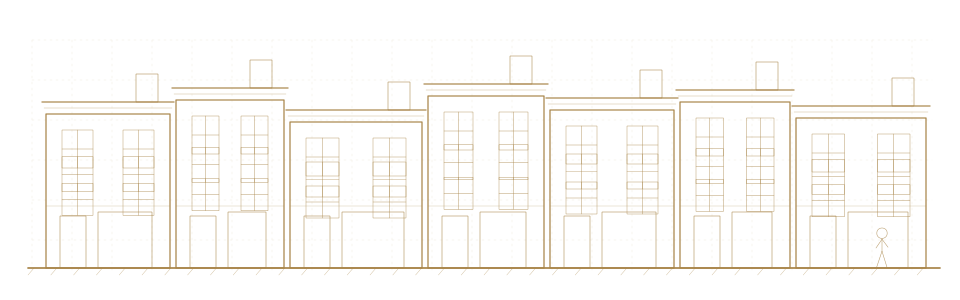
Illustrative study — street elevation — Colindale. Not a completed client project.
Do I need planning permission to extend a house in Colindale?
Often not. Most Colindale housing is undesignated interwar and later stock, where Class A permitted development allows a substantial single-storey rear extension on a semi-detached or detached house and prior approval allows a deeper one. Within Roe Green, Buck Lane or The Watling Estate the position changes — and the first two are Brent designations, where Article 4 coverage of residential conservation areas is a matter of policy.
Is Colindale in Barnet or Brent?
Barnet is returned at the checked research point, but Brent and Harrow both fall within 1,400 metres, and two of the three nearby conservation areas — Roe Green and Buck Lane — are Brent designations. So it genuinely varies by address. Plotting the property on the official boundary layer settles it, and that determines which Article 4 regime, which policies and which fees apply.
What is Roe Green Village?
A First World War garden village built between 1918 and 1920 to a design by Frank Baines, to house workers in the local aircraft industry, comprising in the order of three hundred houses and flats. Brent designated it a conservation area on 1 November 1968. It is protected as a complete planned composition — the layout, the grouping, the roof forms, the materials and the shared open space — rather than for individual buildings.
Can I change the front of a house in a garden-village designation?
It is the part most tightly controlled, because the composition only works when it is consistent. Replacement windows in a different material or pattern, a roof re-covered in a different tile, an enclosed porch or a boundary hedge replaced with a fence are each small individually and collectively erosive — which is what Article 4 coverage exists to control. Restoration at the front and ambition at the rear is the realistic strategy.
How do Barnet and Brent differ on Article 4?
Brent covers all of its residential conservation areas with Article 4 directions as a matter of policy, so an address inside Roe Green or Buck Lane has lost named permitted development rights as a matter of course. Barnet applies directions to ten of its conservation areas, so within a Barnet designation the specific position needs checking. Harrow, also nearby, uses fifteen directions made area by area with differing scope.
Does the new development nearby affect my project?
Not in planning terms for a householder application, but practically it can. Colindale is a designated growth area with substantial construction activity, which affects local traffic, contractor parking and deliveries — particularly where controlled parking applies. It can also affect the availability and pricing of local trades in both directions. Those are programme considerations rather than consent ones, but worth factoring in.
Does a previous owner’s extension reduce my allowance?
Yes. The Class A allowances are measured against the original house — as first built or as it stood in 1948 — so any extension added since counts against what remains. On estates built to a repeating pattern this is usually straightforward to establish, because the unaltered neighbouring houses show the original form. It is the commonest reason a permitted development scheme turns out not to be permitted.
What does a house extension architect in Colindale charge?
We publish fixed-fee packages rather than quoting a percentage before seeing the property, starting with a route review that establishes the responsible authority, the designation and any Article 4 direction, and works out the remaining allowance. Later stages cover the consent drawings, then building regulations and tender information. Structural engineering, site investigation and council fees sit outside the architectural fee.
How much does a house extension cost in Colindale?
Fees for house extensions in Colindale follow scope, consent complexity and whether freeholder or specialist input is required. Published packages for related work start from around £2,250–£3,250 once scope is clear; council, engineer and freeholder surveyor fees are usually separate. See our packages page for current fixed-fee bands — we confirm a fee only after the address and proposed work are understood.
Discuss a house extension in Colindale
Send your Colindale address, photographs of the rear elevation and the side of the house, and details of any extension a previous owner built. We will establish which council decides your application, check the designation and Article 4 position, and set out the consent route with the fixed-fee stage that follows.