Hampstead Architecture and Planning

Westminster / Camden

Licence to Alter Drawings in Covent Garden

We prepare Licence to Alter packs for Covent Garden leasehold homes in WC2: freeholder surveyor drawings for market-quarter mixed-use flats — after the title plan shows whether Westminster or Camden owns any parallel external works.

Last updated

Practice leadership

Eyal Moran, Director and Lead Architect, is an ARB-registered architect, leading design judgement, planning strategy and technical coordination across client projects.

Verify on the Architects Register

The short answer

Do Covent Garden flats need Licence to Alter drawings?

Usually yes for structural openings, wet areas, fire or acoustic changes, and often when market-quarter mixed-use neighbours reshape freeholder method notes. Freeholder consent does not replace Westminster or Camden planning for external works. Confirm authority on the title plan first.

Planning at a glance

Covent Garden

Planning at a glance in Covent Garden
Local planning authorityCity of Westminster and the London Borough of Camden (the boundary runs through the district)
Conservation areaCovent Garden Conservation Area (Westminster side); Seven Dials (Covent Garden) Conservation Area (Camden side) — appraisal adopted The Camden Seven Dials (Covent Garden) area was designated November 1971
Article 4 directionIn effect since Westminster side 31 July 2016; Camden side 3 October 2016 (both basement directions)
Likely approval routeHouseholder planning application or permitted development, depending on conservation status, listing and property type — confirmed for the exact address before drawings begin
Statutory determination time8 weeks for most householder applications (13 weeks for major applications)
Typical drawing package£1,500–£2,750 inc. VAT, fixed fee. Find my package →

Covent Garden freeholder work is a market-quarter mixed-use problem first. Servicing yards, visitor footfall and commercial tenants decide freeholder method notes before any kitchen layout freezes. Public planning only joins when vents or elevations leave the demise — and only after the title plan names Westminster or Camden.

Market-adjacent courts reshape how freeholders expect noisy works, waste routes and temporary loading to be described. A quiet residential-street method note fails freeholder review on WC2 tourist-core pins.

Unlike Soho night-economy freeholder packs, Covent Garden more often opens with daytime visitor footfall and dual-authority location plans. Unlike Holborn institutional-edge freeholder packs, Covent Garden more often turns on market servicing yards rather than legal-court working hours alone.

Bathroom and kitchen moves fail freeholder surveyors on waterproofing, soil stacks and acoustic floors between stacked flats. Furniture boards without drainage notes are refused — freeholder risk first, open-plan second.

Historic fabric is frequent on WC2 pins. Freeholder consent never invents listed openings; listed building consent is sequenced from the same measured model when fabric is touched.

Delivery order for Covent Garden freeholder packs: title-plan authority if external change is likely → lease and agent process → measured demise → freeze openings and wet areas → freeholder pack → building regulations → tender.

Bring the lease, any agent handbook, photos of bathrooms and common stairs, commercial-use notes for the building, and the exact address for the title plan. We will not freeze openings while freeholder constraints are unknown.

The programme killer is freeholder surveyor time plus WC2 loading bays, not CAD production. Start early so a neighbour’s internal fit-out does not set your build date.

Building control stays separate. Freeholder fire strategy and building-control fire strategy must match on multi-unit market-quarter buildings — one technical story, two audiences.

Fees track freeholder surveyor requirements and any dual-authority planning track. Surveyor charges are usually extra. We refuse cosmetic-only packs when structure or fire is clearly engaged.

Vents and rear plant can re-open character questions with the correct council. Freeholder sheets and planning elevations must share openings and materials from one model.

Covent Garden Licence to Alter is freeholder technical coordination for market-quarter demises — not a householder garden extension and not a freehold dig package.

Maisonettes and lateral flats need early notifiable-owner maps so party wall awards do not stall after freeholder principle is agreed.

Past freeholder refusals on the same building are closed in the new pack rather than repeated for the next lessee.

A full Covent Garden freeholder appointment covers authority confirmation when external works apply, lease review, measured survey, freeholder drawings, and sequencing with planning and building regulations only where those tracks truly apply.

We will not reuse freeholder approval from a different market block or a different conservation edge as proof for this pin. Method notes are written to this building’s management regime and WC2 access reality.
Local analysis

What matters in Covent Garden

Covent Garden licence to alter drawings: pin triage

For licence to alter drawings on a Covent Garden pin, start with building type (Covent Garden flats in mansion blocks and converted houses vs Leasehold houses where freeholder consent is required), ownership and Westminster / Camden records — not a catalogue layout.

Private freeholder consent in Covent Garden is not Westminster or Camden permission and not building regulations approval.

Covent Garden planning-data: LPA City of Westminster and the London Borough of Camden (the boundary runs through the district); Covent Garden Conservation Area (Westminster side); Seven Dials (Covent Garden) Conservation Area (Camden side) (The Camden Seven Dials (Covent Garden) area was designated November 1971). The market and Piazza fall on the Westminster side; the Seven Dials star-junction and streets to its north are in Camden — so the authority, conservation area and Article 4 regime depend on the exact address. A Class E-to-residential Article 4 also applies within the Central Activities Zone on both sides.

Covent Garden licence to alter drawings: drawing and evidence order

A useful Covent Garden package for Licence to Alter drawing packs for Covent Garden flats freezes measured existing drawings before proposed depth, then tests neighbour amenity in section against the real host.

Where freeholder or estate consent sits beside Westminster / Camden planning on Covent Garden multi-unit buildings, one measured model should serve both tracks so elevations and method notes do not diverge.

Sequence designations → route → survey → consent drawings → building regulations for Covent Garden.

Covent Garden licence to alter drawings: what delays this page’s projects

On Covent Garden jobs, late surprises usually come from wrong authority assumptions under Westminster / Camden, missing freeholder packs, incomplete elevations, or technical constraints (structure, fire, drainage, acoustics) discovered after the layout freezes.

We change the package when a Covent Garden check fails — different consent, more evidence, or a smaller brief — rather than forcing the first sketch through validation.

Covent Garden licence to alter drawings: delivery after principle

After planning principle or freeholder principle is clear on the Covent Garden pin, building regulations drawings and tender notes turn the approved envelope into construction information for building control and pricing.

Contractors pricing Covent Garden licence to alter drawings need consistent structure, fire, insulation and drainage notes; missing interfaces are how tender exclusions appear.

When vents or elevations change, freeholder packs and public applications must share one measured model. The title plan decides Westminster or Camden — freeholder approval does not pick the council.

Tourist-core freeholder method notes on Covent Garden pins

Commercial-servicing courts and visitor footfall reshape temporary works and working-hour notes freeholders expect — a host problem pure residential mansion packs may not share at the same intensity.

Multi-unit freeholder risk items on Covent Garden stacks

Acoustic floors, fire separation and riser geometry dominate more often than garden massing. We freeze those technical items before open-plan layouts are sold as freeholder-ready.

Local services

How we would approach projects in Covent Garden

What a Covent Garden Licence to Alter pack includes

Demise plans, structural and wet-area proposals, acoustic and fire notes, freeholder method statements, and sequencing notes for any parallel planning or building-control track under the correct LPA.

What we refuse on Covent Garden freeholder enquiries

Cosmetic-only packs when structure or fire is touched; freeholder packs that invent the wrong council; and dig briefs for freehold lower-ground rooms mislabelled as Licence to Alter.

Project routes

Approval routes we would check in Covent Garden

Route A — internal-only freeholder works on a Covent Garden stack

Measured survey → freeholder technical pack → building regulations → tender. No public planning unless vents or plant appear later.

Route B — freeholder works with external vents or elevations

Title-plan authority check → freeholder pack and planning pack from one model → building regulations. Do not issue divergent openings to freeholder and council.

Route C — freehold dig mis-sold as LTA

Redirect to basement design only when freehold subsoil is proven. Licence to Alter is the wrong product for freehold lower-ground digs in Covent Garden.

Local evidence

What the local evidence tells us about Covent Garden

Evidence freeholder surveyors typically request in Covent Garden

Lease demise clarity, photos of common parts, proposed openings with structure notes, acoustic floor build-ups, fire separation strategy, construction method notes for dense access, and title-plan authority when external works apply.

Area facts

Local facts that change the brief in Covent Garden

Fact: Licence to Alter is not a Covent Garden freehold dig product

Freehold digs are different services. Licence to Alter is leasehold freeholder technical coordination for demised flats in WC2.

Fact: freeholder surveyors want building-control-level detail in Covent Garden

Covent Garden freeholder packs typically need existing and proposed plans, structural opening information, acoustic and fire notes, and method statements for works through common parts.

Fact: authority check is freeholder-adjacent, not freeholder-owned

Westminster and Camden boundaries cut through Covent Garden. Freeholder consent is private; public planning authority is still fixed on the title plan when external works apply.

Useful local facts

What Covent Garden homeowners should know

Bring the lease and any freeholder guidance before mood boards. Confirm who controls structure, risers and common parts, and fix title-plan authority if external works are possible.

Local process

How we would sequence a project in Covent Garden

Process: Covent Garden freeholder pack after authority check

Fix LPA if external works are possible → lease and agent process → measured demise survey → technical freeze → freeholder pack → building regulations → tender.

Process: method notes freeholders expect on dense WC2 access

Shared stairs and commercial-servicing courts reshape temporary works and working-hour notes. We write those into freeholder packs early so contractors do not invent suburban delivery routes.

Decision checklist

What to check before starting in Covent Garden

Decision: freeholder pack first, or public planning first?

If works stay inside the demise, freeholder process leads. If external appearance changes, fix the LPA and sequence freeholder and planning so openings match. If the client owns freehold and wants a dig, redirect — not LTA.

Decision: when to stop a Covent Garden Licence to Alter brief

Stop when the lease forbids the works, when freeholder handbooks ban the opening type, or when the client needs freehold rights they do not hold. Redirect honestly.

Thinking about a project in Covent Garden?

Send the address and a short description. We will confirm the likely approval route and the drawings your project needs.

Local planning

Planning & conservation context

Private freeholder consent in Covent Garden is not Westminster or Camden permission and not building regulations approval.

If external works leave the demise, name the correct LPA from the title plan before freeholder and council sheets diverge.

Market-quarter freeholder surveyors usually want building-control-level openings, acoustics and method notes — not planning sketches alone.

Servicing yards and visitor footfall appear on freeholder method notes even for works that stay inside the residential demise.

Historic fabric is checked before freeholder packs describe new openings in listed interiors.

Notifiable owners on converted WC2 buildings are programmed with freeholder packs, not after principle freezes a layout that needs awards.

Building-control drawings follow freeholder principle so market-quarter multi-unit works keep one fire story.

Earlier freeholder refusals on the same block are closed in the pack rather than repeated.

Covent Garden character areas and listing are confirmed for freeholder external details and any parallel public applications under the correct LPA.

A pure Westminster elevational precedent is not reused on a Camden-edge pin without a title-plan check.

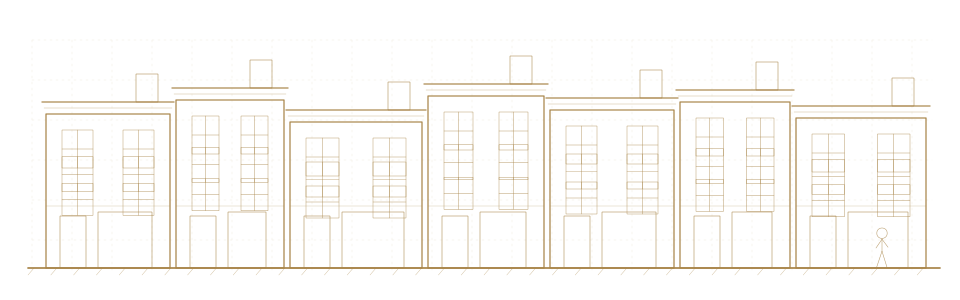
Illustrative study — street elevation

Architecture in Covent Garden: FAQs

Which council handles freeholder works in Covent Garden?

Freeholder consent is private. Public planning, if needed, follows whichever of Westminster or Camden owns the pin on the title plan.

What usually fails freeholder review on Covent Garden mixed-use conversions?

Acoustic floors, fire separation, services risers, and incomplete method notes for noisy works next to commercial-servicing courts. Kitchen furniture alone rarely unlocks freeholder principle.

Can freeholder approval replace building control on a Covent Garden flat?

No. Freeholder surveyors and building control are separate audiences. We keep one technical story so fire and waterproofing do not diverge.

What should a Covent Garden lessee bring to a Licence to Alter appointment?

Lease extract, freeholder guidance if any, photos of wet areas and common parts, use history if commercial adjacency applies, and confirmation of the exact address for title-plan authority.

How are fees structured for Covent Garden Licence to Alter drawings?

Fees follow freeholder complexity and whether a dual-borough planning track is required. Freeholder surveyor charges are usually separate.

Are Soho freeholder packs the same as Covent Garden packs?

Not automatically. Soho more often turns on night-time economy adjacency; Covent Garden more often opens with dual-authority checks and tourist-core courts.

When does public planning join a Covent Garden Licence pack?

When external appearance changes under the correct LPA. Freeholder packs and planning sheets must share one measured model.

Can freeholder approval replace listed building consent in Covent Garden?

No. Freeholder consent is private. Openings in listed fabric can still need listed building consent and, where external, the correct LPA planning track.

Can a freehold dig brief be treated as Licence to Alter in Covent Garden?

No. Freehold lower-ground digs are a different product. Licence to Alter is for leasehold freeholder technical coordination on demised flats.

Need Licence to Alter drawings in Covent Garden?

Send your Covent Garden address, lease notes if available, and a short description of the works. We will outline the freeholder pack your project is likely to need.

Call 020 8054 8756Send Details