Hampstead Architecture and Planning

London

Architects in Elephant and Castle

Elephant and Castle’s research point returned Southwark, with Lambeth also appearing within 1,400 metres. The radius produced a dense set of records including St Georges Circus, Trinity Church Square, Pullens Estate, Walworth Road, Borough High Street, Waterloo and several Lambeth designations. Such density makes the address more—not less—important. The search does not place a property inside any returned boundary, so authority and conservation mapping must precede claims about context, consent or architectural response.

Last updated

The short answer

Which council decides planning applications in Elephant and Castle?

Southwark is the authority returned at the checked point for Elephant and Castle, making it the likely destination for a typical local application. Lambeth also appeared within 1,400 metres though, so a property close to the borough line could be determined there instead. Only an address-level check against the official map settles it for certain.

Planning at a glance

Elephant and Castle

Planning at a glance in Elephant and Castle
Local planning authorityConfirm for the exact property address; the neighbourhood research point is not an address result
Likely approval routeConfirm from the exact address, property type, ownership, designation and proposed work before drawings begin
Statutory determination time8 weeks for most householder applications (13 weeks for major applications)
Where most projects startPlanning Route Review — £395 inc. VAT, credited in full against your package if you proceed. Find my package →

A proposal associated with St Georges Circus should be explained differently from one associated with Pullens Estate, Trinity Church Square or no designation. Elephant and Castle drawings should therefore follow the verified map result and show the actual intervention, access, servicing, height and material changes as relevant. The project’s planning history and decision-maker need confirming before a consent route is recommended. Nearby Waterloo, Lambeth Palace or Borough High Street records should never be added simply to create a richer but unsupported narrative.

Technical coordination at Elephant and Castle should define the premises, shared systems and existing fabric through survey and available property records. Structure, fire strategy, acoustic separation, envelope performance and service routes then need coordinating around the real proposal. Where a mapped conservation relationship makes plant, rooftop work or facade changes sensitive, resolve them before planning and technical information diverge. The Southwark-Lambeth boundary result should appear on every consultant brief; the long radius list supplies no substitute for premises-specific evidence.

Local analysis

What matters in Elephant and Castle

Elephant and Castle planning-authority boundary evidence

Elephant and Castle is represented by a Southwark research point and a radius that also reaches Lambeth. Before either borough’s policy is applied, map the exact premises and project boundary. Keep the official result with the brief, because it determines forms, contacts and validation assumptions.
Elephant and Castle exact-address authority check

The second borough has no automatic role: it remains proximity unless an evidenced project relationship says otherwise. If Lambeth rather than Southwark contains the address, the procedural route must follow Lambeth. The locality name cannot be used to bridge or blur the administrative boundary.

Elephant and Castle nearby conservation evidence

Thirty-five distinct conservation records make the Elephant and Castle radius one of breadth, not certainty. St Georges Circus and Walworth Road sit among Kennington, Lambeth Palace, Waterloo, South Bank and many other polygons.

Elephant and Castle designation decision

Screening should narrow that field before any contextual narrative is written: map the address, retain coverage or a credible proposal-specific setting relationship, and document all other names as exclusions. Consult the matching appraisal only for a verified area. The dataset does not disclose designation, history, use, construction, fabric or significance for an individual property.

Elephant and Castle feasibility and fee sequence

Paying for developed design before anyone has confirmed whether Southwark or Lambeth will determine the application is the most expensive mistake made around Elephant and Castle, where both authorities appear within 1,400 metres of the checked point. Sequence the fees so a short feasibility stage resolves that boundary question and screens the crowded field of nearby conservation records first.

Elephant and Castle programme realities

Planning drawings and the application itself then follow as a second purchase, shaped by whichever council and constraints the checks actually confirmed. Technical design money comes last, and programme expectations should stay hedged, because even the familiar householder target of around eight weeks only applies once a valid application sits with the confirmed authority.

Local services

How we would approach projects in Elephant and Castle

Elephant and Castle project routes and services

Where an Elephant and Castle brief is still loosely defined, begin with feasibility rather than a full appointment. That stage establishes whether Southwark or Lambeth governs the address and which of the many nearby designations deserve attention. Consent-driven projects then move to planning drawings and a managed planning application.

Choosing the right service in Elephant and Castle

A lawful development certificate can suit modest works instead, if the checks support it. Building-regulations drawings come next, turning any approval into information a building-control body can assess. For construction pricing, technical design and tender packages carry the scheme to contractors. Ask for whichever of these fits the decision you actually face, not the whole sequence at once.

Local evidence

What the local evidence tells us about Elephant and Castle

Elephant and Castle survey evidence

The correct response to thirty-five nearby records is disciplined selection. Elephant and Castle sheets should establish the premises and proposed external work at readable, comparable extents; additional sections and views earn their place by resolving scale, levels, visibility or a mapped relationship.

Elephant and Castle drawing coordination

If St Georges Circus, Walworth Road or another polygon applies, state that exact connection and show the affected element. The remaining radius names belong in the audit record. The title must use the address-confirmed Southwark or Lambeth route and should never suggest both boroughs determine the proposal.

Local process

How we would sequence a project in Elephant and Castle

An Elephant and Castle programme should not authorise detailed geometry until the authority, premises boundary and applicable conservation record are settled. Filter the radius evidence, inspect planning history and agree which consent audiences need information.

Elephant and Castle technical delivery sequence

The planning package can then use proportionate views and the correct official context. Structural, fire and building-control specialists should develop the stable scheme. Keeping rejected records in a short exclusions schedule prevents the dense central search from repeatedly reopening the project brief.

Thinking about a project in Elephant and Castle?

Send the address and a short description. We will confirm the likely approval route and the drawings your project needs.

Local planning

Planning & conservation context

More than thirty conservation names were found around Elephant and Castle, spanning both Southwark and Lambeth contexts. Similar proximity does not make St Georges Circus, Trinity Church Square, Kennington or Lower Marsh interchangeable. A source schedule should confirm Southwark or Lambeth for the premises, reduce the list to the relevant polygon and record exclusions. The official research says nothing about the property’s use, construction or significance, and it cannot establish a permission requirement without the proposed work and address-level records.

For the wider local-authority picture — policies, timescales and application routes — see planning in Southwark.

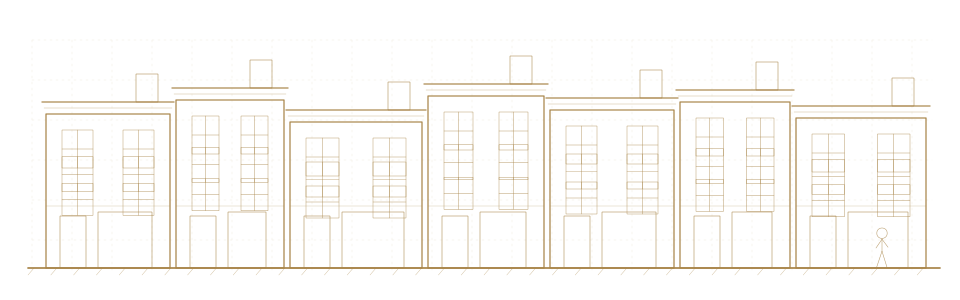
Illustrative study — street elevation

Architecture in Elephant and Castle: FAQs

Does the Southwark point result settle every Elephant and Castle site?

No. Southwark was returned at the checked point, but Lambeth also appeared within 1,400 metres. Confirm the precise premises before choosing policy, forms or a planning team, because nearby central sites can sit across the authority boundary. That check gives an Elephant and Castle client the correct Southwark or Lambeth route before central-area assumptions enter the brief.

Why must the Elephant and Castle conservation list be filtered?

The radius returned more than thirty separately named records across Southwark and Lambeth. They show proximity, not cumulative designation. Map the property and use only the official boundary genuinely covering or materially related to the proposed work. The design team can then work from the one relevant boundary instead of treating more than thirty names as a collective constraint.

What technical evidence matters for an Elephant and Castle premises?

Surveyed fabric, premises limits, shared services, structure, fire and acoustic conditions matter. None can be inferred from the locality or conservation-radius names. Coordinate them around the verified proposal and carry the confirmed authority across every specialist instruction. Specialists receive an Elephant and Castle proposal tied to surveyed premises and one confirmed authority, not the surrounding radius.

How is a conservation-area check actually carried out for an Elephant and Castle address?

The address is plotted first, because proximity lists prove nothing on their own. The architect then reads the official map for the confirmed borough, Southwark or Lambeth, and records whether any boundary actually covers the property. Around Elephant and Castle that means testing names such as Walworth Road or Pullens Estate individually rather than assuming they apply. A written negative result is kept when nothing covers the site.

What should an Elephant and Castle homeowner gather before appointing an architect?

Bring the full postal address, any title or lease paperwork, and whatever earlier consent letters or drawings the property already holds. Photographs of the rooms and the rear elevation help, as does a plain list of what you want to change. In Elephant and Castle it is also worth noting which walls are shared, since the Party Wall etc. Act may apply. None of this needs professional preparation.

Discuss an architecture project in Elephant and Castle

Send the Elephant and Castle address, photographs and intended work. We will identify the authority, designation and building questions to resolve before a full design or technical package is commissioned.

Call 020 8054 8756Send Details